
Paper has a strange way of taking over a home. It arrives a few pieces at a time, and before you know it there is a pile you are afraid to touch.
The good news is that none of this requires a filing system worthy of an accountant. It just takes a few small habits that keep the chaos from ever building up.
Here are twenty-seven of them. Some you can do in the next ten minutes, and a few might change how your whole house feels.
The Ten-Second Habit That Kills the Mail Pile

Most paper problems begin the exact same way. The mail comes in, lands on the counter, and starts to multiply.
The fix is almost embarrassingly simple. Sort it the second it comes through the door, before you set anything else down.
Junk goes straight into recycling. Bills and anything needing action go in one spot, and the rest gets tossed on the way past.
It costs about ten seconds a day. Those ten seconds are the whole difference between a clear counter and a pile you dread.
The Folder That Handles What You Keep Forgetting
There is a special kind of paper that is not junk but is not filed either. It is the permission slip, the form, the thing that needs you to do something.

These are the papers that slip through the cracks. They get set down ‘just for now’ and then become a late fee.
Give them a single home. One bright folder, kept somewhere you actually look, labeled with the only word that matters here.
That word is ‘action.’ Everything inside it is something you owe the world, and seeing it in one place means it finally gets done.
Why Your Mailbox Is Working Against You

You can be the most organized person alive and still lose. As long as paper keeps arriving, you are bailing water out of a boat with a hole in it.
So plug the hole. Switch your bills, bank statements, and anything routine over to paperless.
Most companies make it a two-minute change in your account settings. The reward is a mailbox that suddenly holds a fraction of what it used to.
Less paper coming in means less paper to manage. It is the rare fix that keeps working long after you forget you did it.
The Machine That Buys You Peace of Mind
Some papers you cannot simply toss in the recycling. Anything with an account number or your signature is a gift to the wrong kind of person.
This is what a small shredder is for. It turns a risky pile into a bag of harmless confetti.
Keep it right next to where you sort the mail. The closer it sits, the more you will actually use it.
There is a strange satisfaction in the sound it makes. It is the sound of a worry disappearing.

The Box That Swallows the Chaos
Loose paper is the problem. The moment it has a container, it stops being clutter and starts being storage.
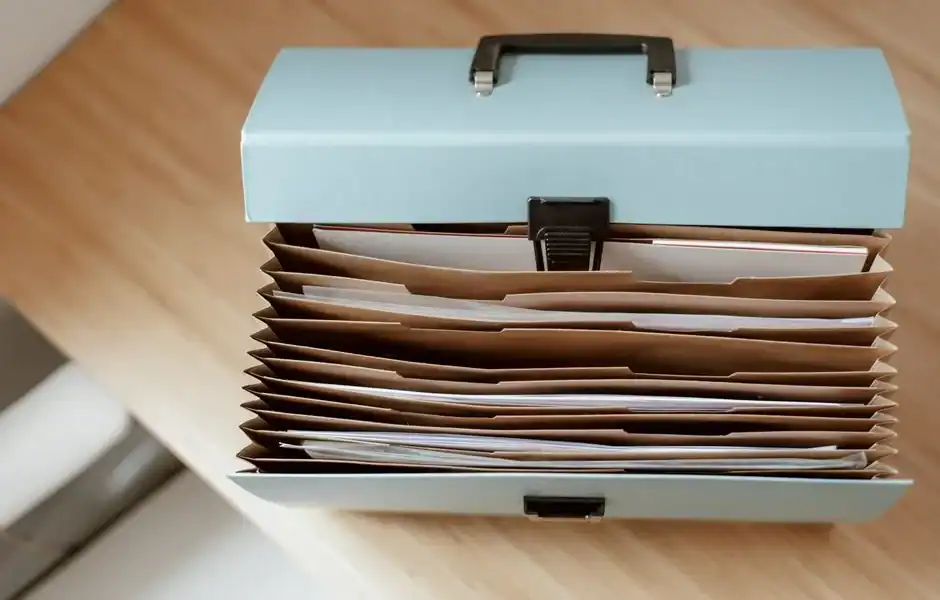
A simple file box with hanging folders does the job beautifully. It is cheap, it is portable, and it hides everything inside.
Give each folder one clear job, like taxes, medical, or home. Keep the labels boring and specific.
When every paper has a folder, filing stops being a chore. It becomes a two-second reflex instead.

The Real Reason You Can Never Find Anything
It is rarely that you lost the paper. It is that you never told yourself where it lives.
A folder with no label is just a slightly neater pile. Your future self has no idea what is inside it.
So label everything, clearly and out loud. If a label maker feels fussy, a marker on masking tape works just as well.
The goal is that anyone in the house could find the car insurance in under a minute. That includes you at your most frazzled.

The Tray That Stops the Countertop Creep
Papers spread like spilled water when there is nowhere for them to go. They take the whole counter because the whole counter is available.

A single tray changes the physics of it. Suddenly there is one small place things are allowed to land.
Call it the ‘to file’ tray and empty it once a week. The tray holds the mess so your surfaces do not have to.
It is a tiny boundary, but boundaries are the entire game here. Give the paper less room and it takes less room.
The App That Turns Paper Into Nothing

The best-organized paper is the paper that no longer exists. Once a document lives safely on your phone, the original is just taking up space.
A free scanner app turns any receipt or letter into a tidy PDF in seconds. Snap it, name it, and let it live in the cloud.
Warranties, manuals, and important letters are perfect candidates. You will always have them, and you will never dust them.
Do keep the true originals, like your birth certificate. But for everything else, a photo is lighter than a folder.
Touch It Once, and It Is Gone
Most clutter is really just a decision you keep postponing. You pick up the paper, feel unsure, and put it back down.
The one-touch rule ends that loop. When a paper is in your hand, it does not get set back down undecided.
You either act on it, file it, or bin it. Right then, while it is already in your fingers.
It feels ruthless at first. Then it feels like the most freeing rule you have ever kept.
The Corner That Ends Late Fees Forever
Bills get paid late for a boring reason. They get separated from the thing you need to pay them.

Fix it by building one small station where money lives. A spot with your checkbook, stamps, and a folder for what is due.
When everything you need sits in one place, paying a bill takes minutes instead of a scavenger hunt. The excuse simply disappears.
Set a standing day to sit there, even just twice a month. The corner does the remembering so your brain does not have to.
Where the Manual Is When You Finally Need It
Nobody reads the manual until something breaks. And of course, that is exactly when it has vanished.
Round up every warranty and instruction booklet into one binder. Slip each into a clear sleeve so nothing falls out.
Now the day the dishwasher acts up, the fix is a page away instead of a mystery. You look like a genius for the price of a binder.
Toss the manuals for things you no longer own while you are at it. Half that pile is for a printer you got rid of years ago.

The Folder You Hope You Never Open
There is one set of papers you truly do not want to hunt for in a crisis. Insurance cards, test results, a list of medications.

Keep them together in a single medical folder. Calm, clearly labeled, and easy for anyone to grab.
In a stressful moment, nobody can think straight. Having it all in one place does the thinking for you.
Tell one other person in the house where it lives. A folder only helps if someone can find it.
The One Day a Year That Changes Everything
Even a good system slowly fills up. Papers that mattered in January are just weight by December.
So pick one day a year to clean it all out. Many people use tax season, since the papers are already in their hands.
Go folder by folder and be honest about what you still need. Shred the rest without ceremony.
You will be amazed how much you were storing for no reason. A yearly purge keeps the whole system light.
The Rainbow Trick That Speeds Up Everything
Your eye finds color faster than it reads words. That tiny fact can make your files quicker to use.
Give each big category its own color. Green for money, red for medical, blue for the house, whatever makes sense to you.
Now you are not scanning labels one by one. You reach for the green and your hand already knows the way.
It sounds like a small thing. In a hurry, it is the difference between five seconds and five minutes.

The Spot Every Piece of Paper Goes First
Paper needs a front door, not a dozen scattered landing spots. When it can land anywhere, it lands everywhere.
Choose one place where all incoming paper goes to wait. A basket, a tray, a single drawer by the entry.
Nothing gets filed or handled from there. It is simply the holding pen until you process it.
One entry point means one place to check. The rest of your home stays gloriously paper-free.
The Folder That Saves You Every April
Tax time turns calm people into frantic ones. Usually because the documents are scattered across the whole house.

Beat it before it starts with a folder that fills up all year. Every tax-related paper goes in the moment it arrives.
Donation receipts, income forms, anything your accountant might want. It waits patiently until you need it.
When April comes, you are not searching. You are just handing over a folder that did the work for you.
Why the Fridge Is Not a Filing System
School papers breed faster than almost anything. Flyers, art, forms, and reminders arrive by the backpack-full.
Taping them to the fridge feels like managing it. Really, it just moves the pile to a vertical surface.
Give each kid a folder or a slim bin instead. Action items go in one place, keepsakes in another.
At the end of the year, keep only the handful that made you smile. The rest can go without guilt.
Where the Good Ideas Actually Live
Recipes, clippings, and little bits of inspiration always go missing. They get shoved in a drawer and never seen again.
Give them a home worth returning to. A single binder or box for the ideas you actually want to keep.
Now the recipe you loved is not lost to the junk drawer. It is waiting exactly where you would look.
Be picky about what earns a spot. A small, loved collection beats a giant one you never open.
The Two Piles That Fix Almost Everything
People overcomplicate paper by inventing a dozen categories. In truth, almost every page is one of two things.
It is either something you need to do, or something you need to keep. Action or reference, and nothing else.
Sort by that single question and the fog lifts. Action gets handled, reference gets filed, and the piles shrink fast.
You can add detail later if you want. But this one split does the heavy lifting all by itself.
The Copy That Survives the Flood
Some documents cannot be replaced with a quick phone call. Losing them to a fire or a leak is a genuine nightmare.

The answer is a second copy that lives somewhere else entirely. A scan saved to the cloud is safe from anything that can happen to paper.
Do this for the handful of truly irreplaceable ones. Birth certificates, deeds, passports, the family records.
It takes an afternoon at most. It buys a kind of calm that is hard to describe until you have it.
How to Make the Junk Stop at the Source
Sorting junk mail is a game you can never win. Every letter you toss, three more are already on the way.
So stop playing defense and cut it off upstream. A few minutes spent unsubscribing does more than a year of sorting.
Opt out of the credit offers, the catalogs, the endless flyers. Most have a number or a website that ends it for good.
The pile does not just shrink. It stops arriving in the first place.
The One Page Your Family Will Thank You For
There is a document nobody wants to make and everybody wishes existed. It is the list of your accounts and where things are kept.

Not passwords scattered on sticky notes, but one clear, secure record. Where the will is, who to call, what matters.
It feels a little morbid to write. It is actually one of the kindest things you can leave behind.
Keep it somewhere safe and tell one trusted person it exists. On the worst day, it will feel like a hand on the shoulder.
The Receipts Worth Keeping, and the Ones That Are Not
Most receipts are trash the moment you walk out of the store. A few, though, are worth their weight in gold.
Keep the ones tied to warranties, big purchases, taxes, or anything you might return. Let every coffee and gas receipt go.
Snap a photo of the keepers and let the paper itself go. A digital receipt never fades to a blank slip.
The trick is knowing the difference. Ask if you would ever actually need to prove this, and the answer sorts it instantly.
Where to Put the Maybe
Not every paper says yes or no right away. Some sit in a genuine maybe, and forcing a decision just stalls you.
Make peace with that by keeping a ‘someday’ file. A single spot for the ideas and papers you are not ready to release.
The key is to revisit it now and then. A maybe that never gets reviewed is just clutter with a nicer name.
When you come back with fresh eyes, most of it turns into an easy no. The rest earns its place.
The Wall That Frees Your Whole Desk
Desks fill up because paper needs a surface, and the desk is the nearest one. The clutter is not a habit problem, it is a space problem.
Look up instead of down. A set of file pockets mounted on the wall creates storage out of thin air.
Sort your active projects into them, one pocket each. Everything stays visible without eating your workspace.
Suddenly the desk is for working, not for stacking. The paper found a home that was never in your way.

The Weekly Ritual That Keeps It Clear
A system that only gets attention once a year always drifts. Small and steady beats big and rare every time.
So give paper fifteen minutes a week. Same day, same spot, like watering a plant.
Empty the trays, file the strays, shred what is done. It never piles up because it never gets the chance.
Fifteen minutes feels like nothing. Skipping it for a month is what feels like everything.
The Papers You Are Legally Allowed to Burn
A lot of paper gets kept out of vague fear. We hold onto things ‘just in case’ with no idea of the actual rules.

Most documents have a real shelf life. Utility bills, old bank statements, and expired warranties can usually go long before you think.
A quick look at how long you truly must keep something is freeing. Often the honest answer is: not anymore.
Keep the few things the law and common sense require. Let the rest meet the shredder with a clear conscience.